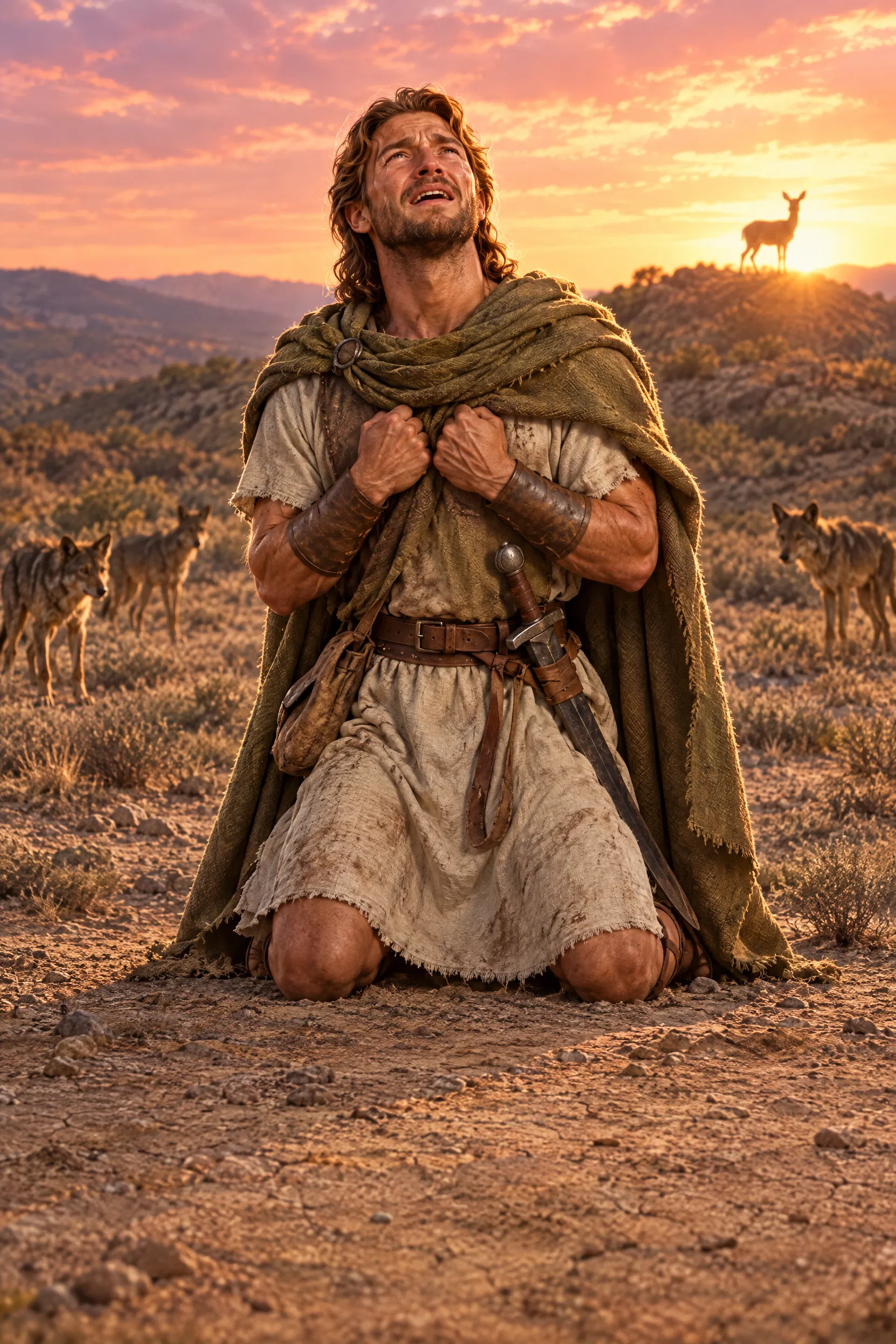
David Cries Out in the Wilderness Among Wild Dogs

A young man with a sword at his belt kneels on dry ground with his fists at his chest and his face lifted, wild dogs around him and a deer on the ridge at dawn.
Prompt
Psalm 22, as David's own lament during his flight from King Saul, in the Judean wilderness: David, the young fugitive in a dusty knee-length tunic and olive-brown cloak with a sword at his belt, kneels on the cracked dry ground of a desert hillside at dawn, both clenched fists pressed to his chest and his face lifted to the sky in an anguished cry, "My God, my God, why have you forsaken me?" He is large and central, fully clothed. A pack of lean wild desert dogs prowls in a loose circle around him at a distance. On the ridge behind him a single graceful hind, a female deer, stands outlined against the brightening rose and gold sky of morning. Open wilderness only: no cross, no crucifixion, no execution, no soldiers, no crowd. Style: a blend of photo-realism and cinema, like a still from a big-budget film. Bright, rich, saturated, luminous colour, clear daylight or glowing golden light even in dramatic scenes, never murky or muddy, crisp detail, real human faces full of emotion, shallow depth of field, subtle film grain. Simple, uncluttered composition: ONE clear scene from this chapter, with the chapter's main character or characters large, close and central in the upper and middle frame, and a simple background. No montage, no collage, no inset vignettes, no crowd of small figures competing for attention. Historically accurate ancient Near Eastern clothing, architecture and landscape. Keep the bottom quarter of the frame simple and uncluttered (ground, water or sky) so a large chapter number can be set over it. Absolutely no text, no letters, no words, no numbers, no logos, no watermark, no border, no frame.
Characters
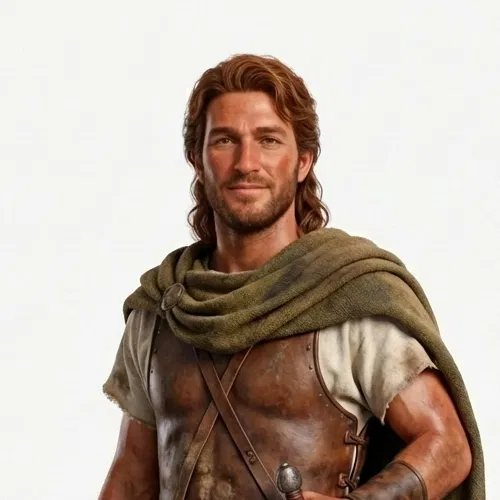 David (Fugitive from Saul)
Comments
No comments yet.